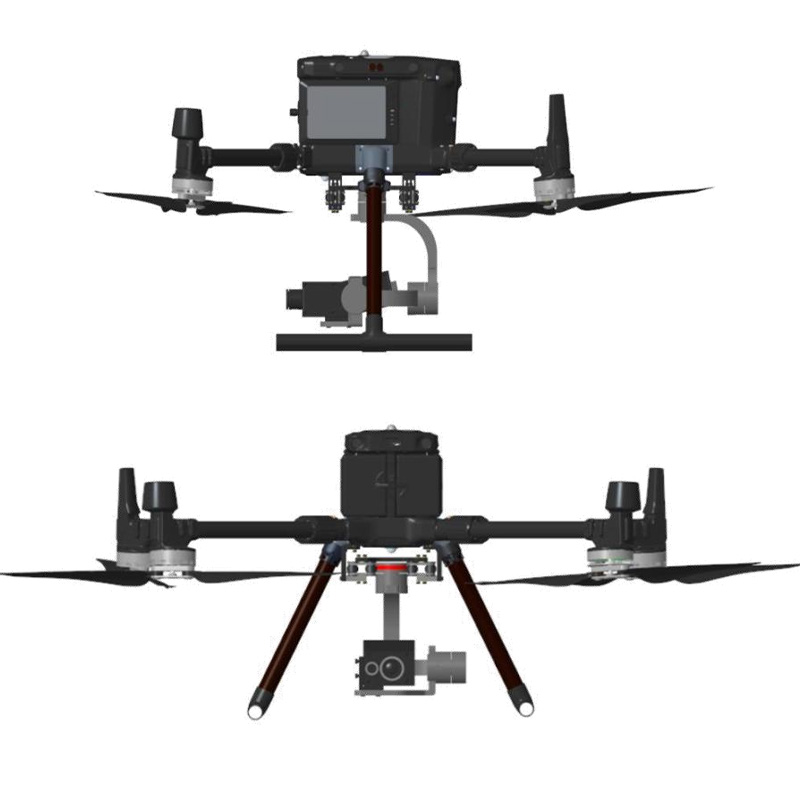
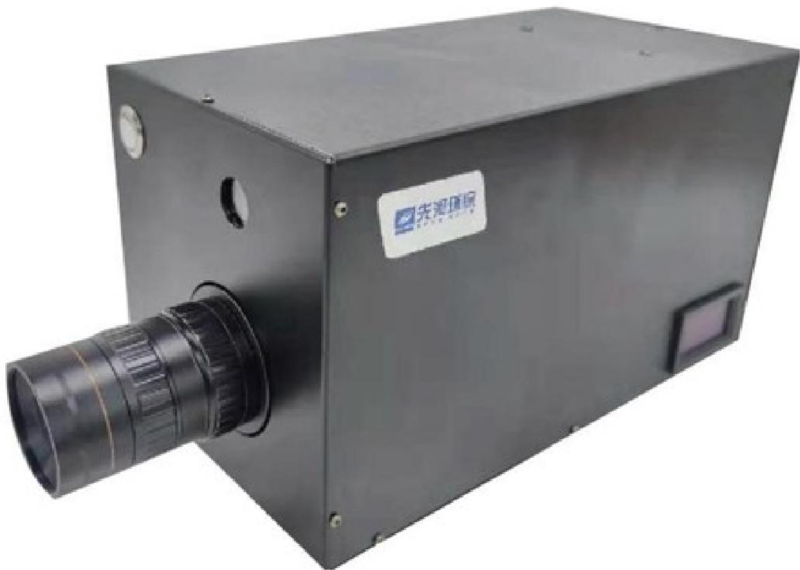
Sailhero Environment adheres to innovation-driven development, independently researching and developing equipment and systems. The company has launched the “Drone-Based Hyperspectral Remote Sensing System,” achieving professional full-process inversion from instrumentation to drone flight data collection to water quality parameter analysis. This advancement has also driven the transformation of traditional river, lake, and marine water quality monitoring from qualitative research to quantitative research. The drone-based hyperspectral remote sensing system will provide more effective and precise technical support for water environment monitoring in China.
The drone-based hyperspectral remote sensing system utilizes a drone equipped with imaging hyperspectral equipment to conduct remote sensing measurements ofthe target area, obtaining images and spectral
information of the target area. This data is then processed using inversion models to calculate spectral data, enabling the determination of over 15 water quality parameters (including suspended solids, turbidity, transparency, zinc, copper, lead, chlorophyll, chemical oxygen demand, dissolved oxygen, total phosphorus, total nitrogen, ammonia nitrogen, permanganate index, colored soluble organic matter, water depth, etc.), as well as custom parameters. It can also estimate vegetation cover and soil type. By organizing and analyzing
the monitoring data, analyzing the spatial distribution and evolutionary trends of parameters in the flight area, and generating reports, pollution tracing analysis can be conducted to achieve precise management of water pollution prevention and control.
The spectral image data cubes obtained by the hyperspectral imaging system feature ultra-high spectral bandwidth, high spectral resolution, and high spatial resolution. Hyperspectral remote sensing imaging
technology has the characteristic of “image-spectrum integration,” enabling the simultaneous acquisition of both spatial images and continuous spectral information of objects. Therefore, hyperspectral images contain more abundant target information compared to panchromatic or multispectral images.
The drone-based system can flexibly capture large-area target images. With high spatial resolution, multiple spectral channels, and high spectral resolution, it can quickly identify sources of excessive pollution. It provides a comprehensive understanding of the overall status of water pollution in an area, helping to diagnose and resolve challenges encountered in water pollution prevention and water quality compliance, and offering a basis for decision-making.
● Contaminated water bodies exhibit unique spectral characteristics distinct from those of clean water bodies;
● These spectral characteristics manifest as absorption or reflection of specific wavelengths of light, and these spectral characteristics can be captured by imaging hyperspectral instruments and reflected in remote sensing images;
● The left figure shows the spectral curve characteristics of typical soil, vegetation, and water bodies, while
● the right figure shows the spectral curves of water bodies with different turbidity levels.
System Composition
| Number |
Configuration List |
Quantity |
| 1 |
XHGGP-90A Main Unit |
1 |
| 2 |
99% Standard Calibration White
Board: 25*28 cm |
1 |
| 3 |
Target Cloth With a Reflectance
Of 40% (3 square meters) |
1 |
| 4 |
Multi-Rotor Drone |
1 |
| 5 |
Drone Batteries, 4 Pieces (2 sets) |
1 |
| 6 |
Drone Packaging Case |
1 |
| 7 |
3-Axis Self-Stabilizing Gimbal |
1 |
| 8 |
Flight Control Remote Controller |
1 |
| 9 |
Data Collection Software |
1 |
| 10 |
Data Processing and Analysis Software XHHSIDAS V1.0 |
1 |
Technical Feature
The drone-based hyperspectral remote sensing system is capable of high-resolution hyperspectral imaging within the spectral range of 400 nm to 1000 nm, while its weight and size meet the requirements for
integration onto drones.
The drone-based hyperspectral remote sensing system can process the collected hyperspectral data to determine water body extent, extract parameters such as suspended solids, turbidity, transparency, zinc, copper, lead, chlorophyll, chemical oxygen demand (COD),dissolved oxygen, total phosphorus, total nitrogen, ammonia nitrogen, permanganate index, colored soluble organic matter, water depth, and other 15 parameters. Additional parameters can be added according to customer requirements.
Hardware Specifications Table:
| Hardware Index |
Specification |
| Detection Wavelength Range |
400 nm - 1000 nm |
| Spectral Resolution |
≤2 nm @ 546.1 nm FWHM |
| Number of Bands |
≥240 |
| Detective Field of View Angle |
≥20° |
| Data Acquisition Rate |
≥90 fps |
| Total Weight |
≤1.5 kg (excluding drone and gimbal) |
| Spatial Resolution |
0.1 m (at a height of 300 m) |
| Image Resolution |
1000 x 1200 pixels (per image) |
Software Function Table:
| Software Function |
Function Realization |
| Data Collection Function |
Supports automatic exposure, capturing whiteboard and dark-field data,
hyperspectral data, auxiliary camera data, as well as posture and GPS
information. |
| Data Process Function |
The software features lens correction, reflectance correction, atmospheric
correction, stitching single images into panoramic images, extracting water
body boundaries, spectral data inversion for 15 water quality parameters, and
mapping the obtained data cubes onto satellite maps based on GPS coordinates. |
| Result Analysis Function |
The software features inversion analysis, correlation analysis, extreme value
statistics, distribution statistics, and other functions, and can display analysis
images and data statistics tables. |